Menu
Menu
Your Cart

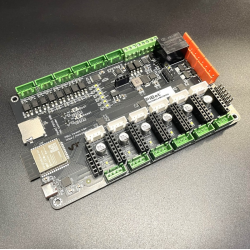
PiBot FluidNC GRBL Laser CNC Controller V4.7 B

PiBot FluidNC GRBL Laser CNC Controller V4.7 B
-30%
PiBot FluidNC GRBL Laser CNC Controller V4.7 B
  • Stock: In Stock
  • Brand: PiBot
  • Weight: 0.11kg
  • SKU: PICOB470B01
19139 samples sold
Product Views: 53182
This offer ends in:
Day
Hour
Min
Sec
$27.99
$39.99
Ex Tax: $27.99

Available Options

FLEXIBLE EXTERNAL-DRIVER CONTROLLER

Six motor-signal channels, a replaceable ESP32 module and flexible spindle/laser control in one practical controller.

V4.7B is built for CNC routers, laser systems and custom motion projects that use external Step / Direction motor drivers. FluidNC provides Wi-Fi WebUI and readable YAML configuration; the board also provides eight inputs, microSD, PWM, laser PWM, adjustable 0–10 V, Modbus RS485, two MOSFET outputs and PiBot expansion options.

6 Outputsexternal EN / STP / DIR
8 Inputslimits, probe and controls
FluidNCWi-Fi WebUI + YAML
Tool ControlPWM · Laser · 0–10 V · RS485
12–24 Vcontroller power input

Why Choose V4.7B?

⚙ Made for external driversSix dedicated 5 V EN / STP / DIR / GND signal groups connect to compatible TB/DM-style industrial drivers or PiBot external stepper-driver modules.
↻ Replaceable controller moduleThe classic 38-pin ESP32 DevKitC / ESP32-WROOM-32 module plugs into the carrier. It can be replaced or selected separately instead of being permanently soldered to the main board.
⚡ One board, many tool interfacesChoose PWM, laser PWM, adjustable 0–10 V, relay control or Modbus RS485 according to the spindle, VFD or laser and the active firmware configuration.
???? Browser-based setupWith FluidNC, upload files, jog, check status and manage G-code from the WebUI over Wi-Fi. Most machine changes are made in a readable YAML file.
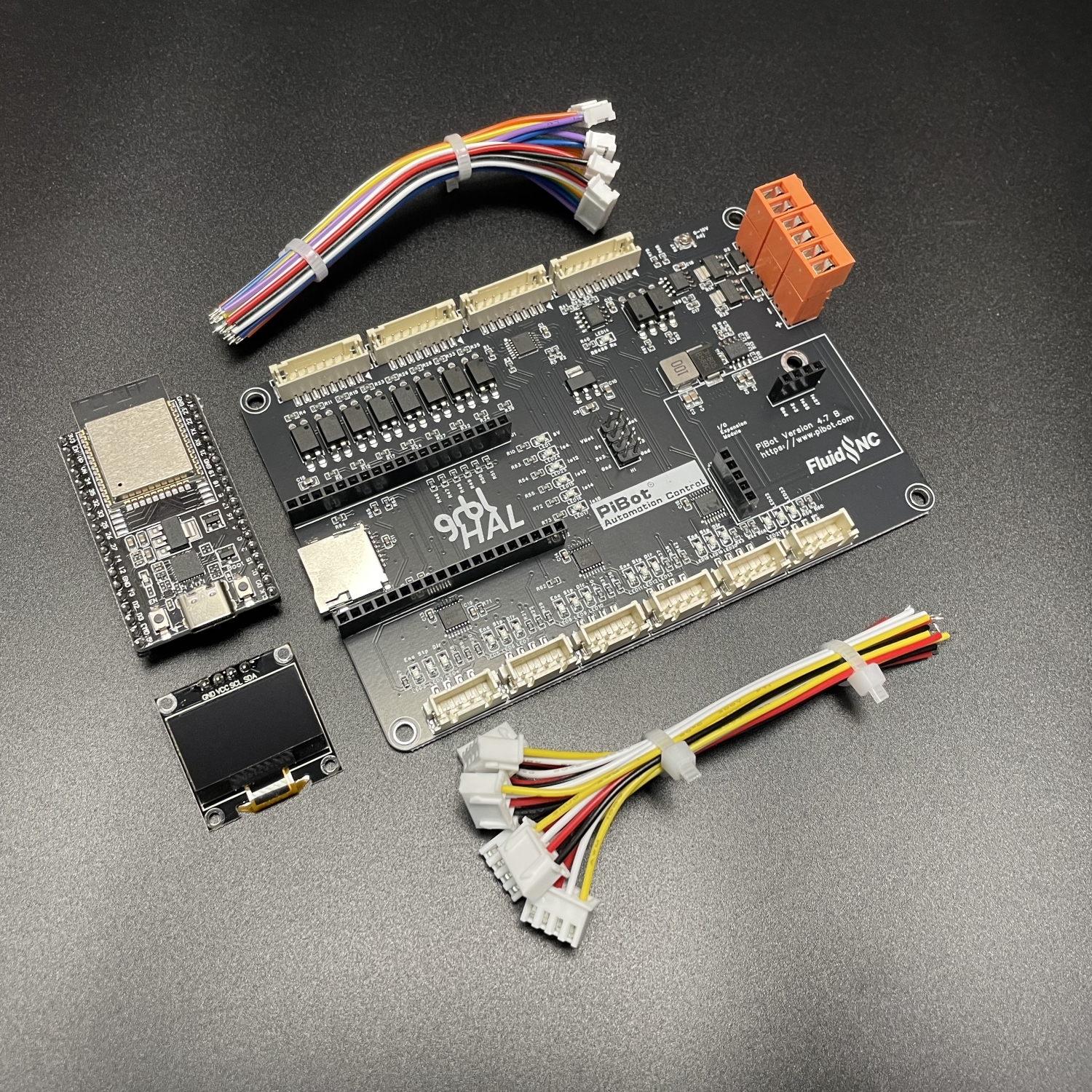
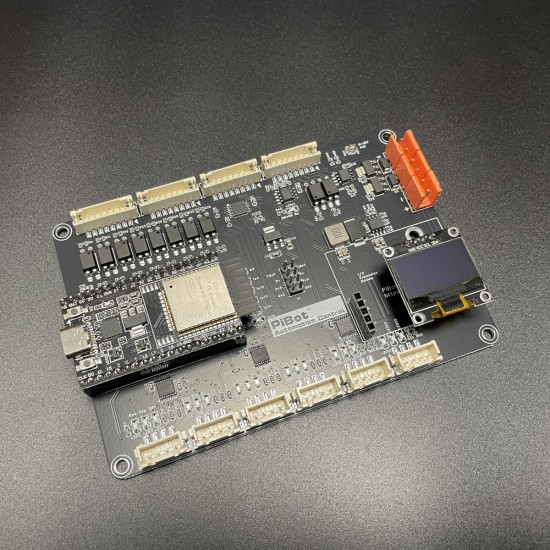
PiBot V4.7B carrier board with classic ESP32 module, OLED and cable options
MODULAR BY DESIGN

A flexible carrier-board system

The controller board is the motion and I/O hub. Add the classic ESP32 module, external motor drivers and only the accessories required by your machine.

Best fitMachines that already use full-size external Step / Direction drivers.
Typical buildsCNC routers, diode lasers, VFD spindles, plotters and custom motion systems.
Choose only what the machine needs ESP32 module, external drivers, cables, OLED, pendant and I/O expander are included only when the matching product option is selected.

FluidNC Ready — The Main Firmware

FluidNC is optimized for ESP32 motion controllers. It provides a built-in browser WebUI and defines the machine in a text-based YAML file, so normal machine configuration does not require compiling firmware. The selected YAML describes the axes, ganged motors, inputs, spindle or laser, networking and accessories.

Wi-Fi WebUIUse a computer, phone or tablet on the same network to jog, upload files, view status and run jobs.
Readable YAMLStart from the supplied V4.7B example and create a separate machine configuration for the actual mechanics and wiring.
USB + microSDUse the USB interface on the selected plug-in ESP32 module and store supported files locally on microSD.
Visual PiBot tutorialFollow the current V4.7B Wiki from module installation through motor, input, PWM, laser, 0–10 V and RS485 checks.
Additional firmware option: the official grblHAL ESP32 project provides a PiBot 6-axis I2S board target for customers who prefer the grblHAL ecosystem. FluidNC YAML files do not configure grblHAL; each firmware uses its own setup method.

Hardware at a Glance

The annotated V4.7B image below is maintained with the current Wiki. It shows the physical connector groups and the assignments used by the supplied bench-test YAML. Final functions remain configurable, so always compare the active YAML before connecting a real machine.
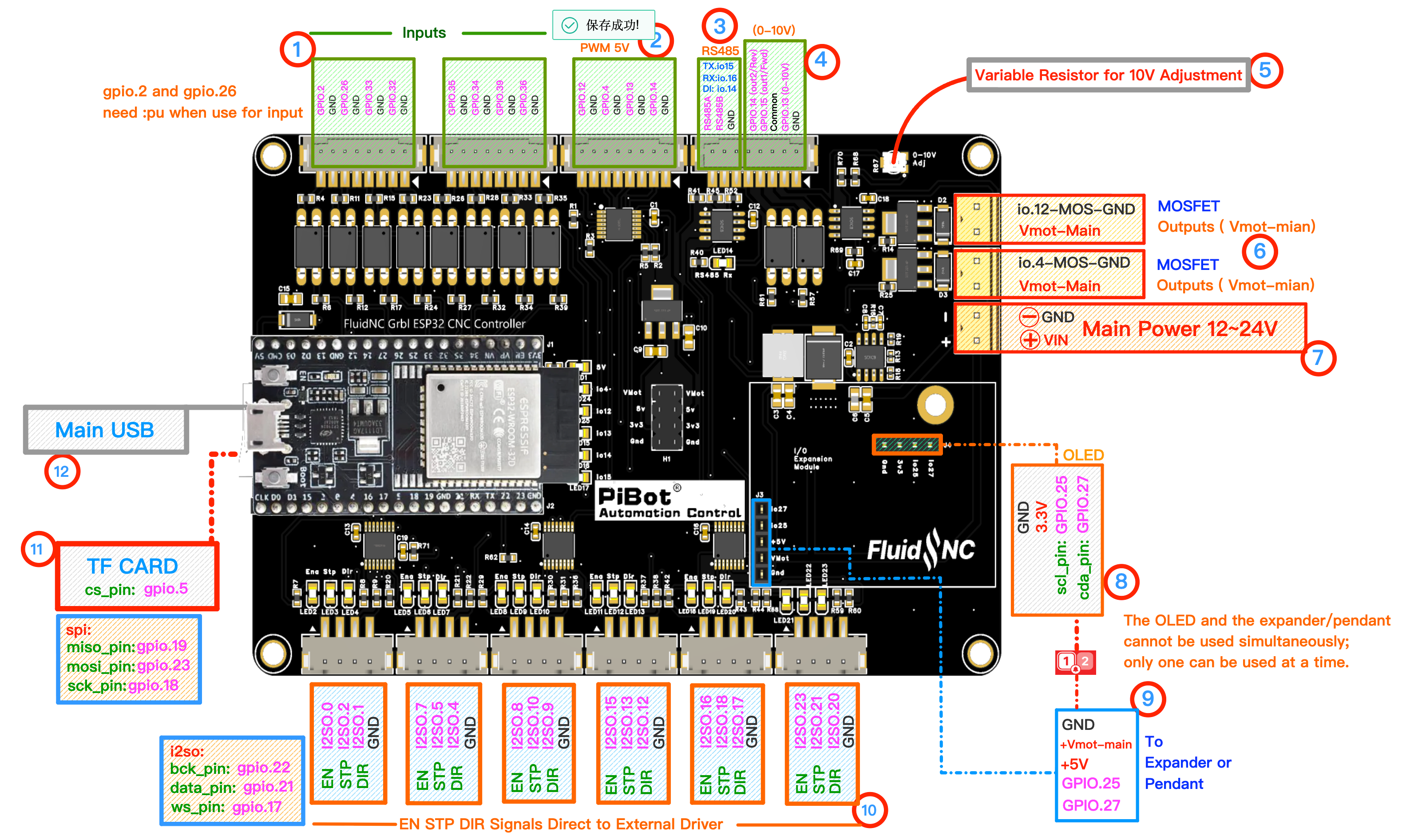
Current PiBot V4.7B pinmap with numbered inputs, outputs, RS485, 0-10V, power, OLED, RJ12, motor connectors, microSD and USB

Current V4.7B pinmap — click to open the full-resolution image.

Eight machine inputsTest YAML assignments cover probe, tool setter and limit inputs. GPIO functions and active level are defined in the YAML.
Six external motor groupsEach physical group carries Enable, Step, Direction and Ground for a compatible external motor driver.
Status LEDsInput, motor-signal, MOSFET and communication LEDs help with first checks before the final load is connected.

Connect the External Drivers Your Machine Needs

V4.7B deliberately uses external motor-driver outputs. This makes it easy to pair the controller with drivers sized for a small router, a multi-motor gantry or a larger machine cabinet. Driver power, motor current, microstepping and wiring must match the selected driver and motor.
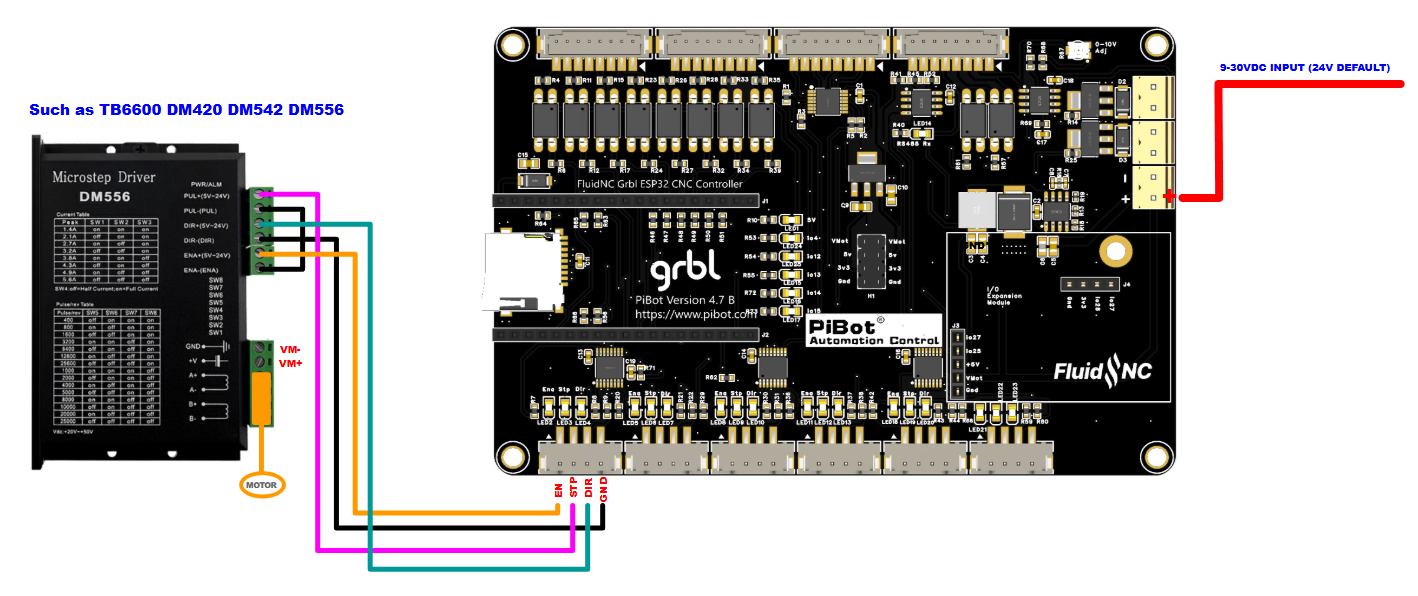
V4.7B connection example for TB6600 DM420 DM542 DM556 style external stepper drivers

Standard TB/DM-style external driver example
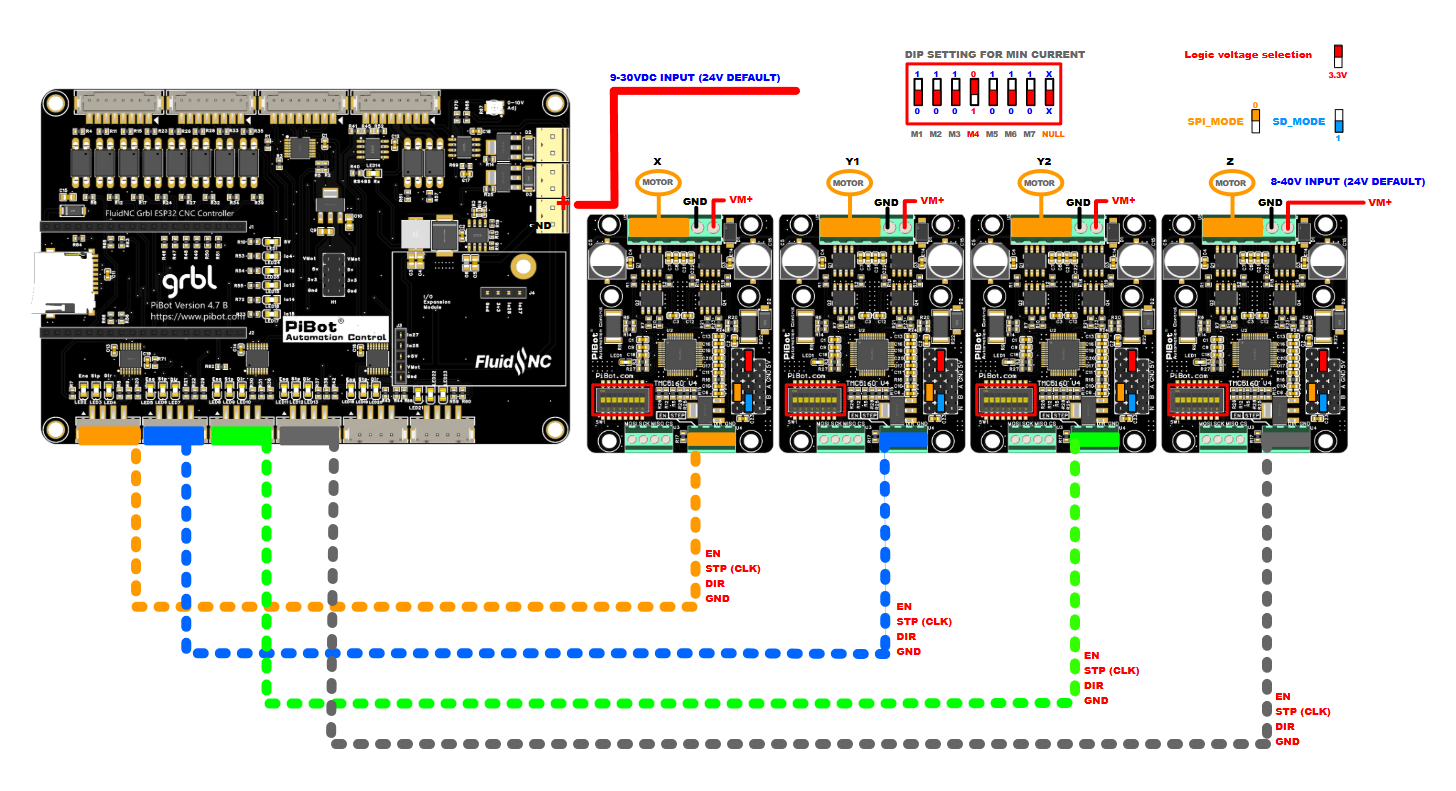
V4.7B connected to PiBot external SilentStep motor driver modules

PiBot external-driver module example

Current V4.7B electrical rule: power the controller from correctly polarized 12–24 V DC. Some retained historical wiring artwork may show a wider range; follow the current Wiki and board revision, not the old caption.
External Stepper Driver Wiring Guide

Spindle, Laser and Auxiliary Control

5 V PWMSpeed-control signal for compatible spindle controllers and other configured PWM devices.
Laser PWMDedicated configured signal path for a compatible laser controller. Validate polarity and voltage with the laser disconnected.
Adjustable 0–10 VAnalog speed command for compatible VFDs, with Forward/Reverse contact alternatives according to configuration.
Modbus RS485On-board MAX3485 interface for supported Modbus RTU equipment. Configure baud, device address and protocol for the actual VFD.

Two light-load MOSFET outputs

GPIO.4 and GPIO.12 also control the matching low-side MOSFET channels. Each channel is limited to 1.5 A maximum on V4.7B.

Use these outputs for suitable light DC loads. For a pump, solenoid, fan or other heavier/inductive load, control an external relay or suitable power driver. Overloading the channel can burn the MOSFET.

Optional Display, Pendant and Expansion

The V4.7B expansion area supports a compatible wired PiBot pendant or I/O expander through the documented RJ12/UART arrangement. An optional OLED can display controller status. Current PiBot pendant communication can use Wi-Fi or the pendant's built-in Bluetooth mode.
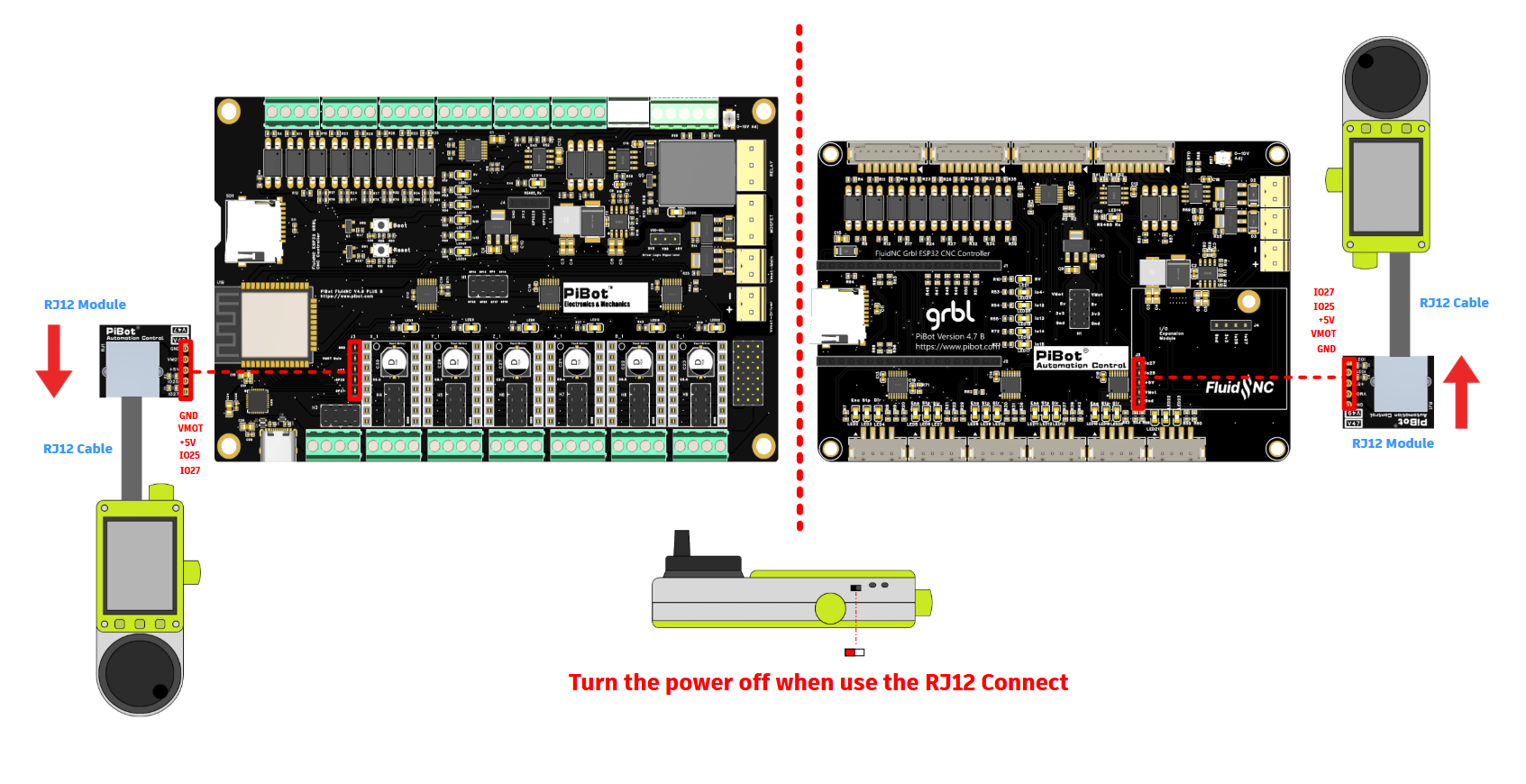
Optional RJ12 module and PiBot pendant connection for V4.7B

Optional RJ12 pendant connection

Wi-Fi pendantUse the current pendant's Wi-Fi connection for the supported wireless workflow.
Built-in BluetoothUse the pendant's built-in Bluetooth mode when selected. No separate Bluetooth converter module is required.
Wired RJ12 optionAvailable for a compatible wired PiBot pendant or I/O expander when configured according to the documented pinout.
Shared pins: OLED and RJ12 use GPIO.25 / GPIO.27. Configure one of these interfaces at a time, power off before connecting an accessory and use the documented PiBot cable/pinout.

V4.7B Specifications

ItemV4.7B
Controller moduleReplaceable 38-pin classic ESP32 DevKitC / ESP32-WROOM-32 module; not ESP32-S3
Main firmwareFluidNC with Wi-Fi WebUI and YAML configuration
Additional firmwareOfficial grblHAL ESP32 PiBot 6-axis I2S target available
Motor outputs6 external 5 V EN / STP / DIR / GND groups; final axes and ganged motors are assigned by firmware configuration
Motor driversExternal drivers only; no on-board StepStick sockets
Inputs8 configurable signal inputs for limits, probe, tool setter and other configured controls
Spindle / laser5 V PWM, laser PWM, adjustable 0–10 V, Forward/Reverse alternatives and supported Modbus RTU over RS485
MOSFET outputs2 low-side channels, 1.5 A maximum per channel; external relay/power driver required for heavier loads
StoragemicroSD card socket
Display / expansion128 × 64 I2C OLED or compatible RJ12 pendant / I/O expander; shared GPIO.25 / GPIO.27 means OLED and RJ12 are mutually exclusive
USBUSB connector and USB-to-UART bridge are provided by the selected plug-in ESP32 module
WirelessWi-Fi through the plug-in ESP32 module; current PiBot pendant communication can use Wi-Fi or the pendant's built-in Bluetooth mode without external Bluetooth converter modules
Controller power12–24 V DC, correctly polarized; main power is required for complete carrier-board operation

What Is Included?

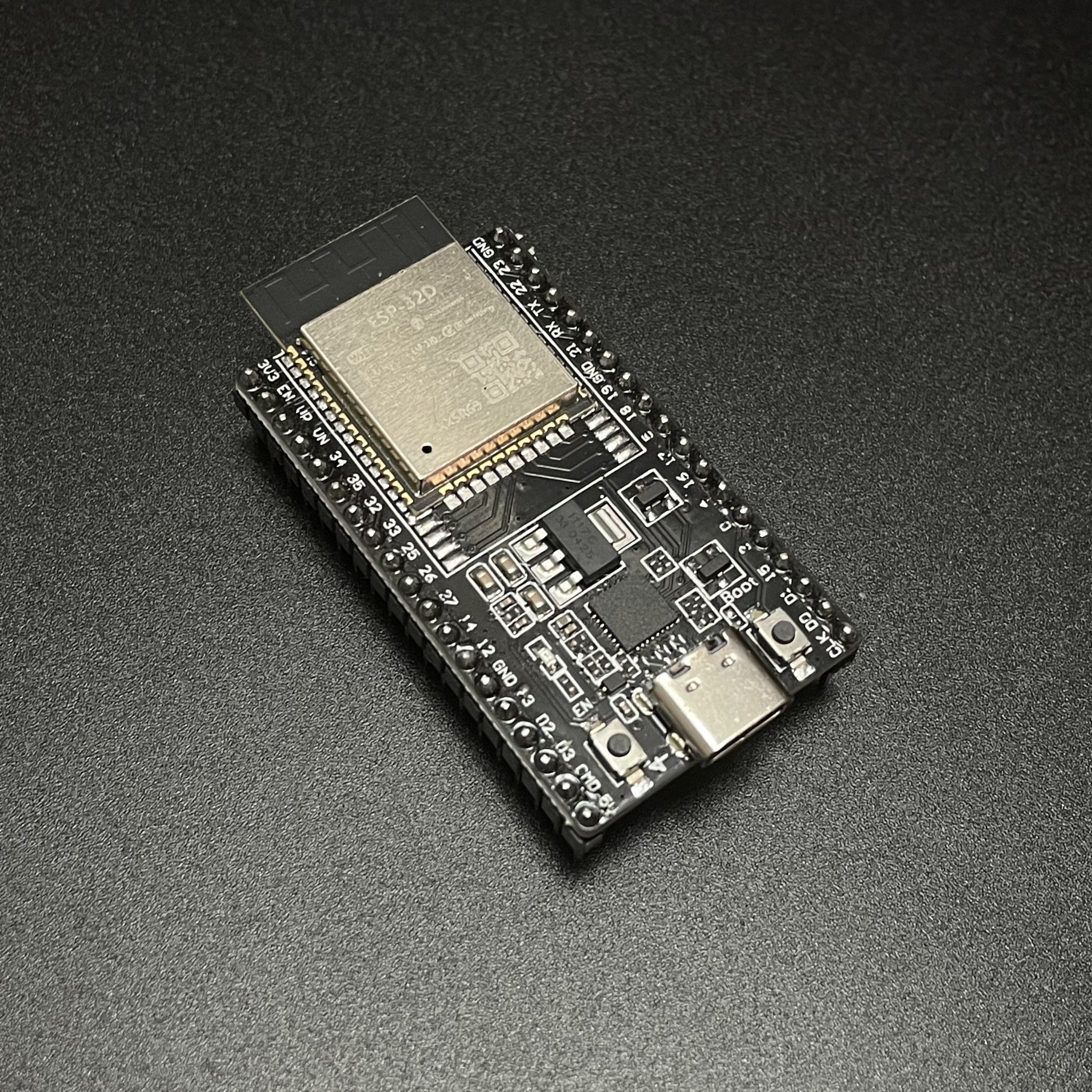
Optional classic ESP32 DevKitC module for PiBot V4.7B

Classic 38-pin ESP32 module shown — optional unless selected.

Base productOne PiBot V4.7B controller carrier board.
Required to operate motorsA compatible classic 38-pin ESP32 module and suitable external motor drivers. They are included only when selected.
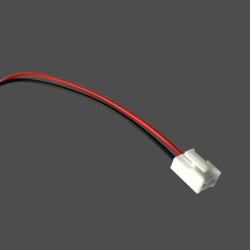
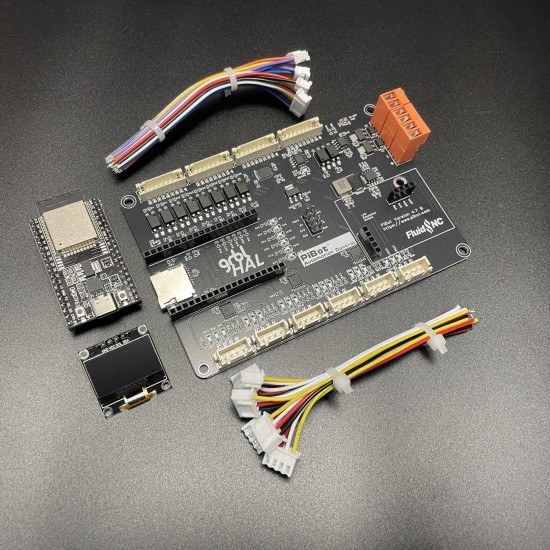
Optional accessoriesCables, OLED, pendant and I/O expander are included only when the matching option is selected and available.
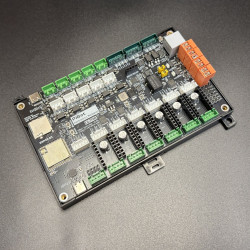
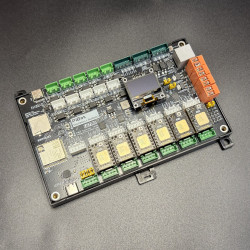
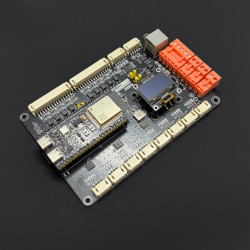
Before ordering: product photos show possible configurations. Check the options above for the exact package contents and available PCB color.

Setup and Hardware Videos

These original videos are retained for visual reference. Interfaces, download packages and example configurations may have changed; use the current V4.7B Wiki for the exact firmware, YAML and command sequence.

Firmware and WebUI overview

Hardware test example 1

Hardware test examples 2 and 3

Product and Reference Gallery

Additional product and connector references are shown below. Current electrical limits, signal assignments and firmware procedures are defined by the V4.7B Wiki and the schematic for the exact board revision.

PiBot FluidNC controller color and board variants

PiBot controller and PCB color gallery; availability follows the selected product option.

Classic ESP32 DevKitC pin reference retained from the original V4.7B listing

Classic ESP32 module reference; connector style may differ with the selected module.
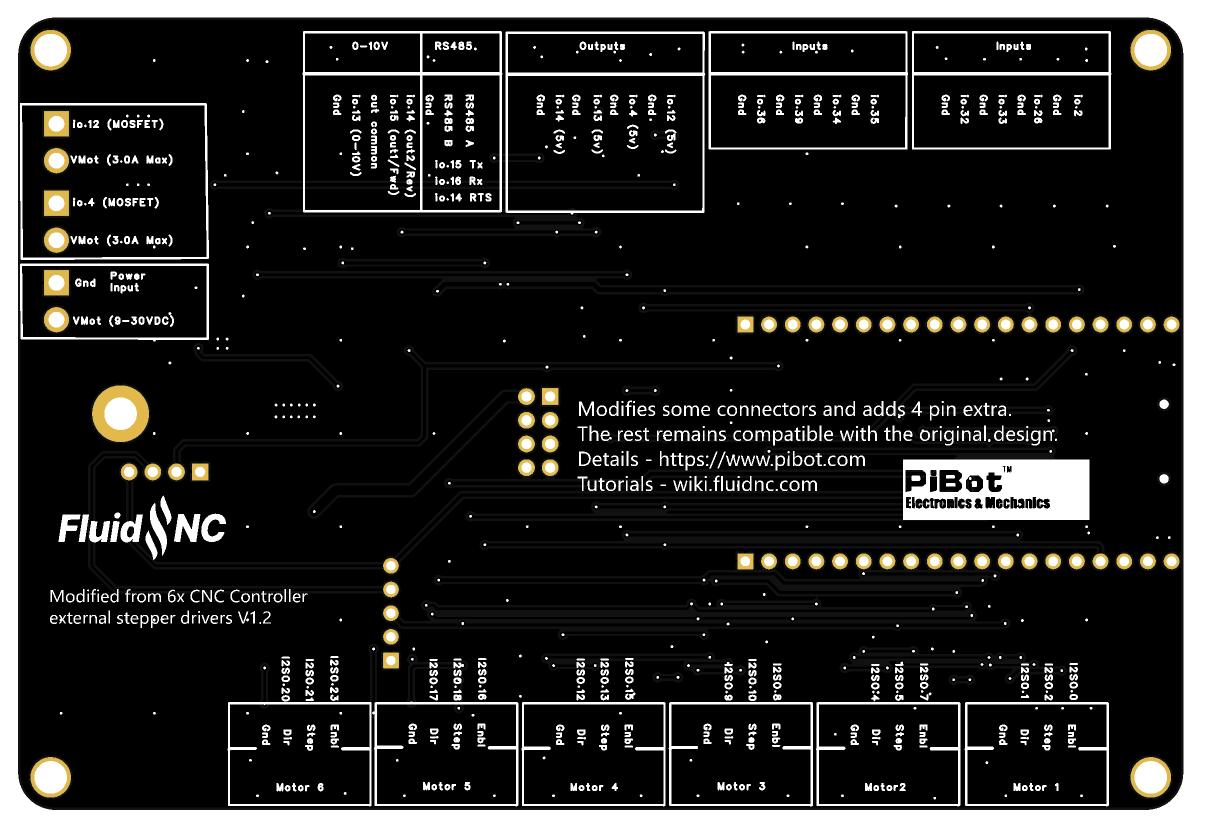
Original PiBot V4.7B connector illustration

Original connector illustration; use the current numbered Pinmap above for the latest labels and 12–24 V limit.

Firmware and Software Compatibility
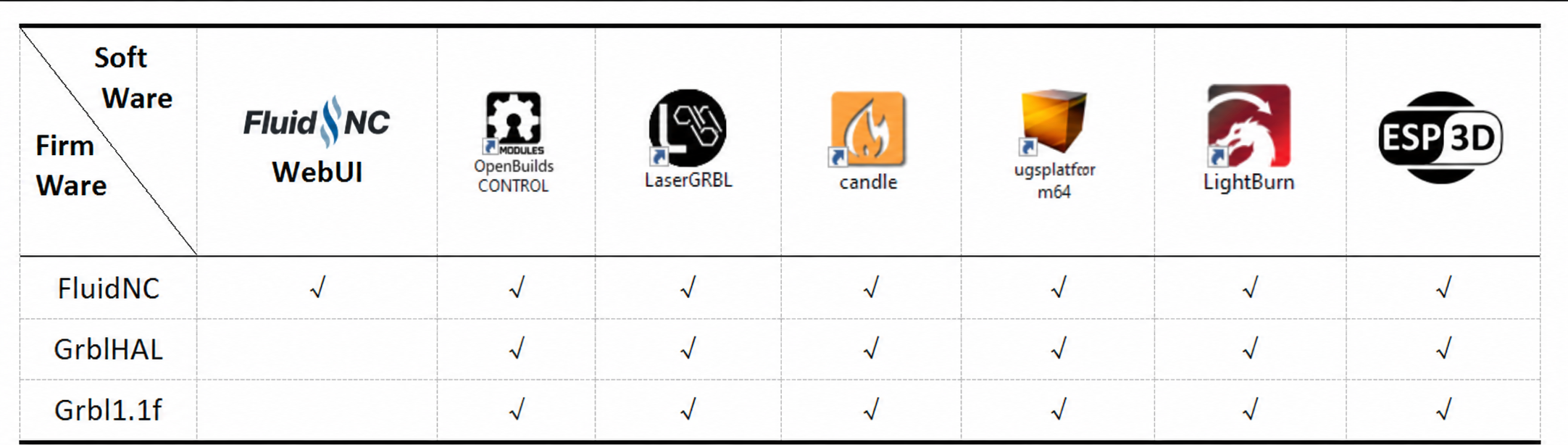
PiBot firmware compatibility chart for FluidNC, grblHAL and GRBL 1.1f with WebUI, OpenBuilds CONTROL, LaserGRBL, Candle, UGS, LightBurn and ESP3D

Compatibility reference updated 2026-08-06. LightBurn officially lists GRBL, FluidNC and grblHAL as supported GCode controller firmware; ESP3D support depends on the selected ESP3D component and firmware build. Check the PiBot Software Introduction and the software vendor's current documentation before final machine setup.

Current V4.7B Schematic
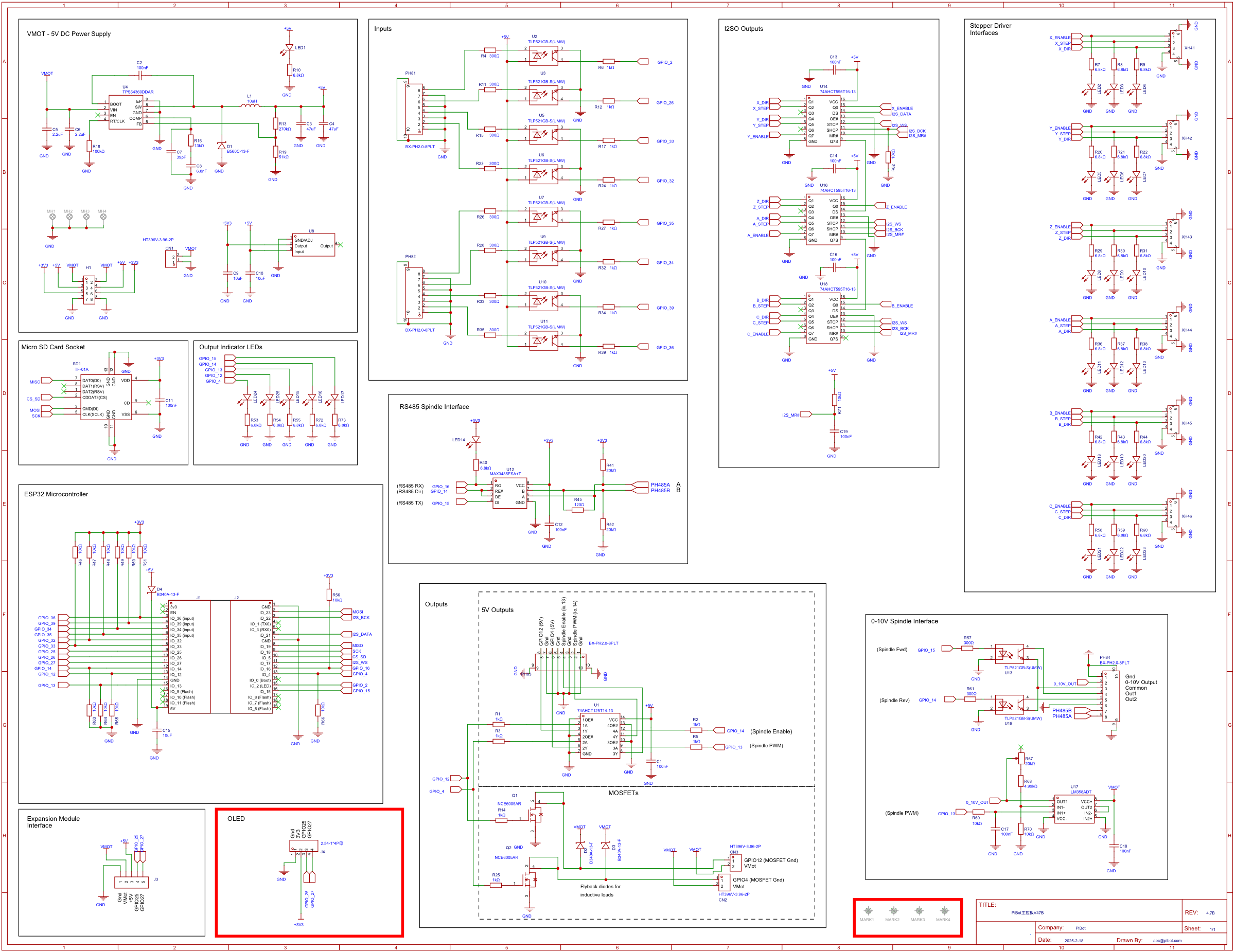
Current PiBot V4.7B electrical schematic

Current V4.7B schematic preview — click the image to open the full PDF.

Before First Power-On

  • Use 12–24 V DC only and verify VIN/GND polarity before applying main power. USB alone is not enough for complete carrier-board testing.
  • Install or remove the classic ESP32 module, OLED, RJ12 accessories and external-driver wiring only while power is off.
  • Test motor signals before connecting motors, and test PWM/laser/0–10 V/RS485 before connecting the final spindle, VFD or laser load.
  • MOSFET limit: 1.5 A maximum per channel. Use an external relay or suitable power driver for heavier loads.
  • The supplied XYYZA YAML is a bench-test profile. Create a separate machine-specific YAML before homing, cutting or engraving.

Quick Buyer FAQ

Does it include the ESP32 module?No, not in the base board-only configuration. Select the ESP32 DevKitC option if you need the compatible plug-in module.
Can it control six motors?It provides six independent external-driver signal groups. The actual axis letters, ganged motors and motion settings are defined by the selected firmware configuration.
Does it have on-board motor-driver sockets?V4.7B is an external-driver carrier and intentionally has no StepStick sockets. It connects to compatible external drivers through 5 V EN / STP / DIR / GND signals.
Can I use spindle and laser functions?Yes, the hardware provides PWM, laser PWM, 0–10 V and RS485 paths. Which functions can operate together depends on signal sharing and the active YAML or grblHAL build.

Documentation, Downloads and Support

PiBot Controller V4.7B · Product description updated 2026-08-06
Write a review

Please login or register to review

Shipping Notification

1. Global Standard (Excluding USA)

  • Rate: $7.99

  • Coverage: Worldwide (excluding the United States)

  • Features:
    Basic international shipping service.

    Also excluding certain regions like: Peru, Ukraine, Thailand, Norway, Israel......

    Free shipping(Orders over USD 116) only available for Globle Standard shipping and eligible destination.

    Customs clearance fees not included.

2. Global Express (Excluding USA)

  • Rate: $27.99

  • Coverage: Worldwide (excluding the United States)

  • Carriers: DHL or FedEx or other agents

  • Key Benefit:
    Duty paid(DDP) service. No import taxes or duties will be charged upon delivery.

    Important! DDP only aviliable in EU, United Kingdom,Norway,Switzerland,Iceland,Thailand......

    For some destinations (such as Peru, Ukraine, Israel, and others), Global Standard shipping is not available and only Global Express service can be selected. Import duties, VAT, and customs clearance charges may still apply unless your country is specifically listed under our DDP (Duty Paid) service. If you are unsure whether your destination is covered by our DDP service, please contact us before placing your order.

3. USA Special Channel (Delivered Duty Paid)

  • Rate: $18.99

  • Coverage: United States only

  • Key Benefit:
    Includes all customs clearance fees and duties.