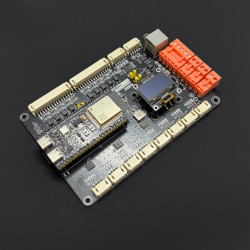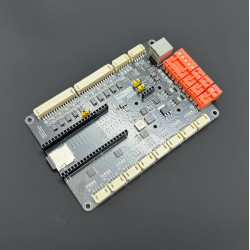
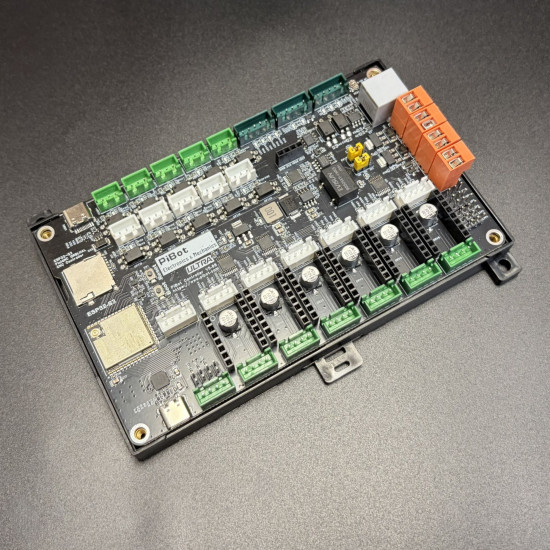
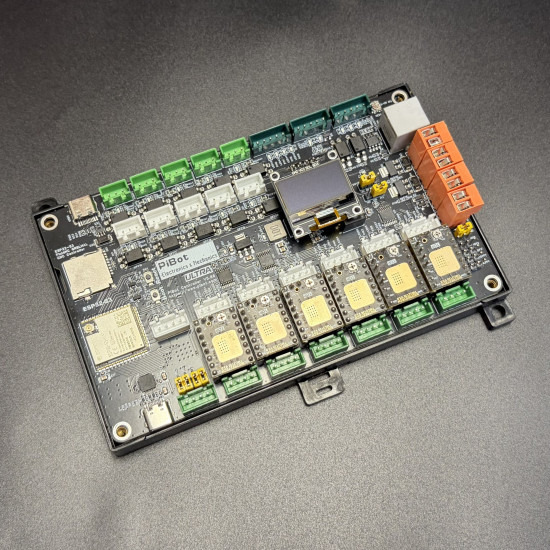
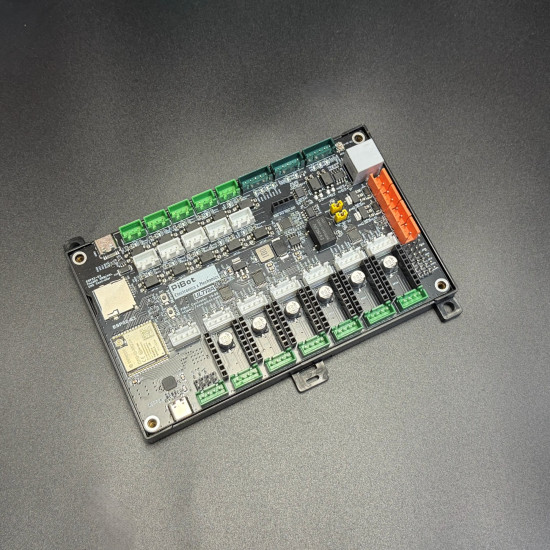
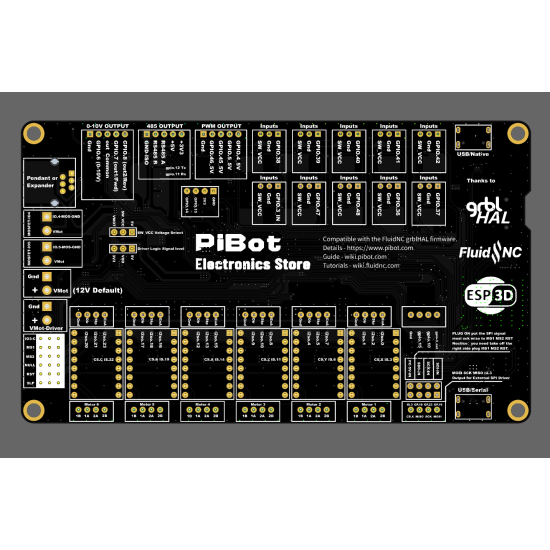


Explore Every Connector and Jumper
Turney’s Builds takes a close-up tour of the V5.88 Ultra, covering its dual USB-C ports, isolated inputs, PWM and 0–10 V outputs, RS485, 500 mA MOSFET channels, stepper-driver connections and configuration jumpers.
Use it with the Pinout Reference: FluidNC signal assignments can be changed in YAML, so the current PiBot Wiki and your machine configuration remain the final reference.
What Does This Board Do?
A computer application or WebUI sends G-code commands such as “move X by 10 mm” or “run the spindle at this speed.” The controller converts those commands into accurately timed electrical signals for motor drivers and machine accessories. The V5.88 Ultra can:
- Read G-code over USB, Wi-Fi or microSD.
- Drive machine motion through on-board plug-in stepper drivers or external industrial motor drivers.
- Control a spindle or laser using PWM, adjustable 0–10 V analog control, relay signals or Modbus RTU over RS485, depending on configuration.
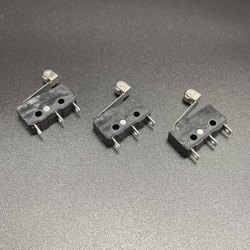
- Read machine inputs including limits, probe, tool setter, emergency-stop and other configured signals.
- Operate accessories such as relays, coolant, air assist or dust extraction through suitable outputs.
- Provide a browser interface with FluidNC WebUI, so the machine can be managed from a computer, tablet or phone on the same network.
Understanding the 6 + 1 Axis Design
An “axis” is one independently controlled Step / Direction / Enable motor-signal group. It can operate one motor channel or an external driver. The exact axis letters and motor assignment are determined by the firmware configuration.
FluidNC Ready — The Main Firmware
The V5.88 Ultra is designed first for FluidNC. It ships with FluidNC ready and uses a readable YAML file to describe the machine: motor channels, limits, probe, spindle or laser, relays, networking and other I/O. Most machine changes are made by editing the configuration file instead of compiling firmware.
FluidNC can use the board’s six dedicated motor channels plus the configurable Extra I/O channel, opto-isolated inputs, PWM and 0–10 V control, MOSFET and relay outputs, isolated RS485, OLED, pendant and expansion connections according to the selected YAML configuration.
Additional firmware option: V5.88 Ultra is also included in the official grblHAL Controllers list, ESP32 board map and Web Builder for customers who prefer that firmware ecosystem.
What Can You Build or Upgrade?
The controller is intended for machines that use Step/Direction motor drivers and compatible spindle or laser-control signals. Always compare the actual motor count, sensor voltage, spindle/VFD interface and safety requirements with the Wiki before purchase.
What Makes the V5.88 Ultra Different?
ESP32-S3 with 8 MB Flash and 8 MB PSRAM
The ESP32-S3-WROOM-1U-N8R8 provides a dual-core LX7 processor, external IPEX antenna connector, 8 MB Flash and 8 MB octal PSRAM. This gives the firmware room for networking, WebUI, storage and motion-control functions. The exact features used depend on the installed firmware build.
Dual USB-C interfaces
One USB-C port uses a CP2102 USB-to-serial interface for normal serial communication and flashing. The second is connected to the ESP32-S3 native USB interface. Use the port specified by the relevant installation or test guide.
10 opto-isolated machine inputs
Ten TLP521GB-S optocoupler channels with reverse-blocking protection provide pull-low inputs for limits, probe, tool setter, safety and other configured signals. Use dry contacts or compatible NPN (sinking / open-collector) sensors; PNP sensors cannot trigger these inputs. The SW-VCC jumper selects the switch-side supply arrangement. Input count does not mean every possible function can be used simultaneously; plan the assignment for the actual machine.
On-board and external drivers on all six dedicated channels
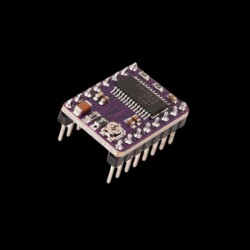
Each dedicated motor channel has a Pololu-format socket and an external 5 V Step / Dir / Enable connector. The documented plug-in driver families include A4988, DRV8825, TMC2208, TMC2209, TMC2130 and TMC5160. Per-axis SPI chip-select routing is provided for the six dedicated channels; driver jumpers and firmware configuration must match the selected module.
Independent peripheral connections
The hardware provides separate connections for OLED, RJ12 pendant/UART, I/O expander and Modbus RS485. Their assignments are selected in the FluidNC YAML configuration to match the machine.
Galvanically isolated RS485
The RS485 section uses an ADUM3201 digital isolator, B0505XT isolated DC/DC supply and SN65HVD3082E transceiver. This separates the RS485 side electrically from the controller side and is intended for supported Modbus RTU equipment such as compatible VFDs. Correct grounding, shielding, termination and firmware configuration are still required.
PWM, relay and adjustable 0–10 V spindle control
The board includes PWM-capable outputs, relay-control signals and an LM358-based adjustable 0–10 V circuit for compatible VFDs. Measure the output and direction signals with a multimeter before connecting a spindle drive. The selected firmware determines which logical spindle is assigned to each physical signal.
Protected low-side MOSFET outputs
Two low-side MOSFET outputs include flyback protection for suitable DC loads. The board-level limit is 500 mA maximum per channel. Use an external relay, SSR or driver for larger loads; do not use the MOSFET component’s headline current rating as the controller-output rating.
42 status LEDs
LEDs indicate power rails, input states, motor Step/Direction/Enable activity, MOSFET activity and communication signals. They provide a quick first check during installation, but a multimeter is still required when validating analog, spindle, laser or supply voltages.
4-layer PCB and shared enclosure footprint
The 146.5 × 87 mm 4-layer PCB uses the same mounting footprint as V4.96 Pro, allowing the optional PiBot DIN-rail enclosure to be shared between the two board families. The controller input range is 12–24 V DC only.
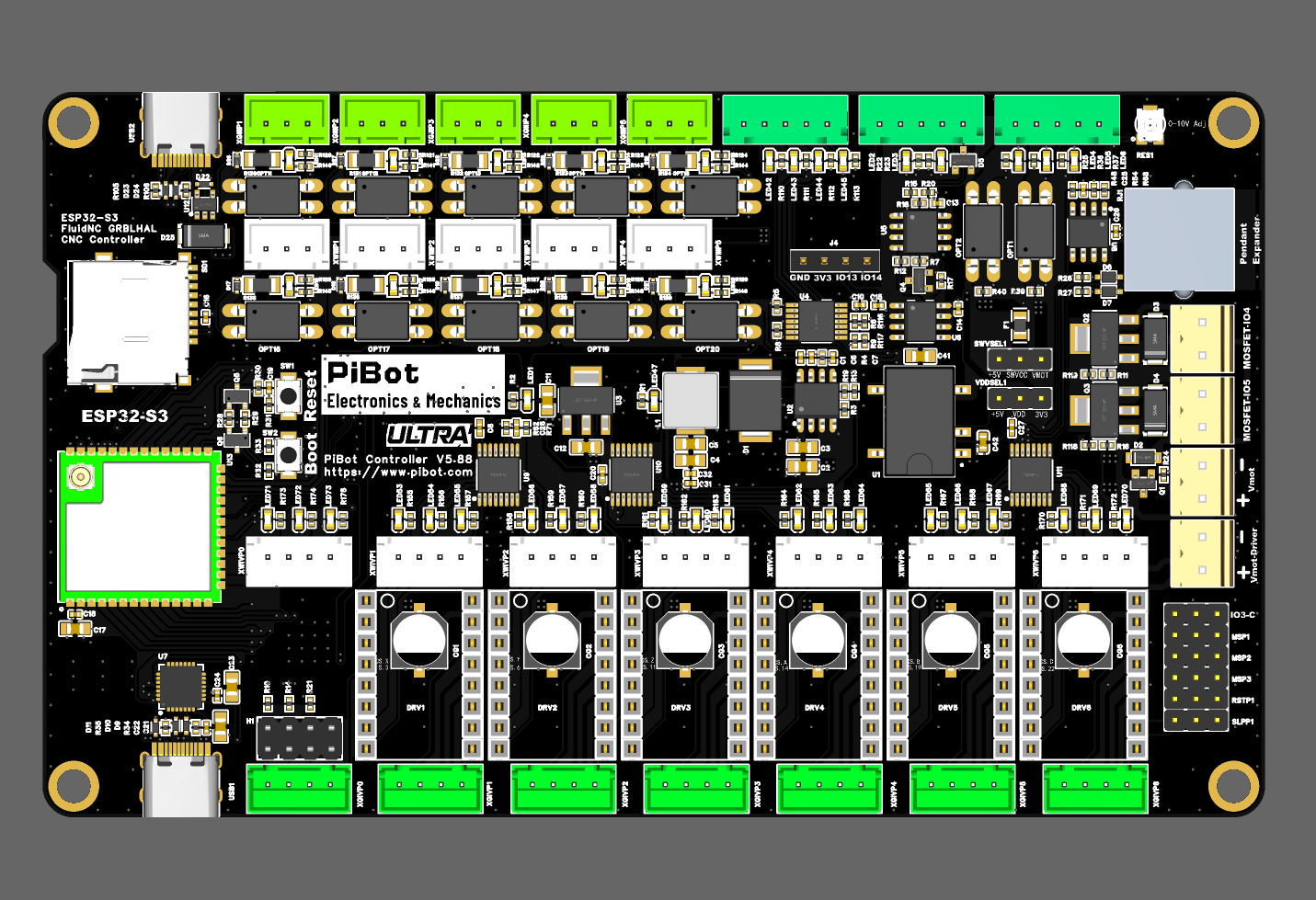
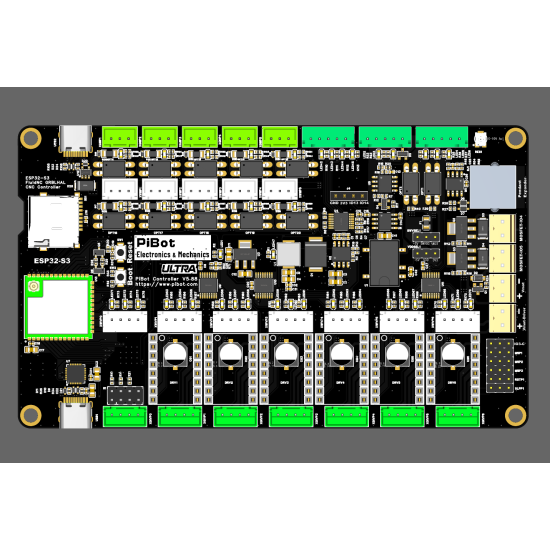
Top-side component layout
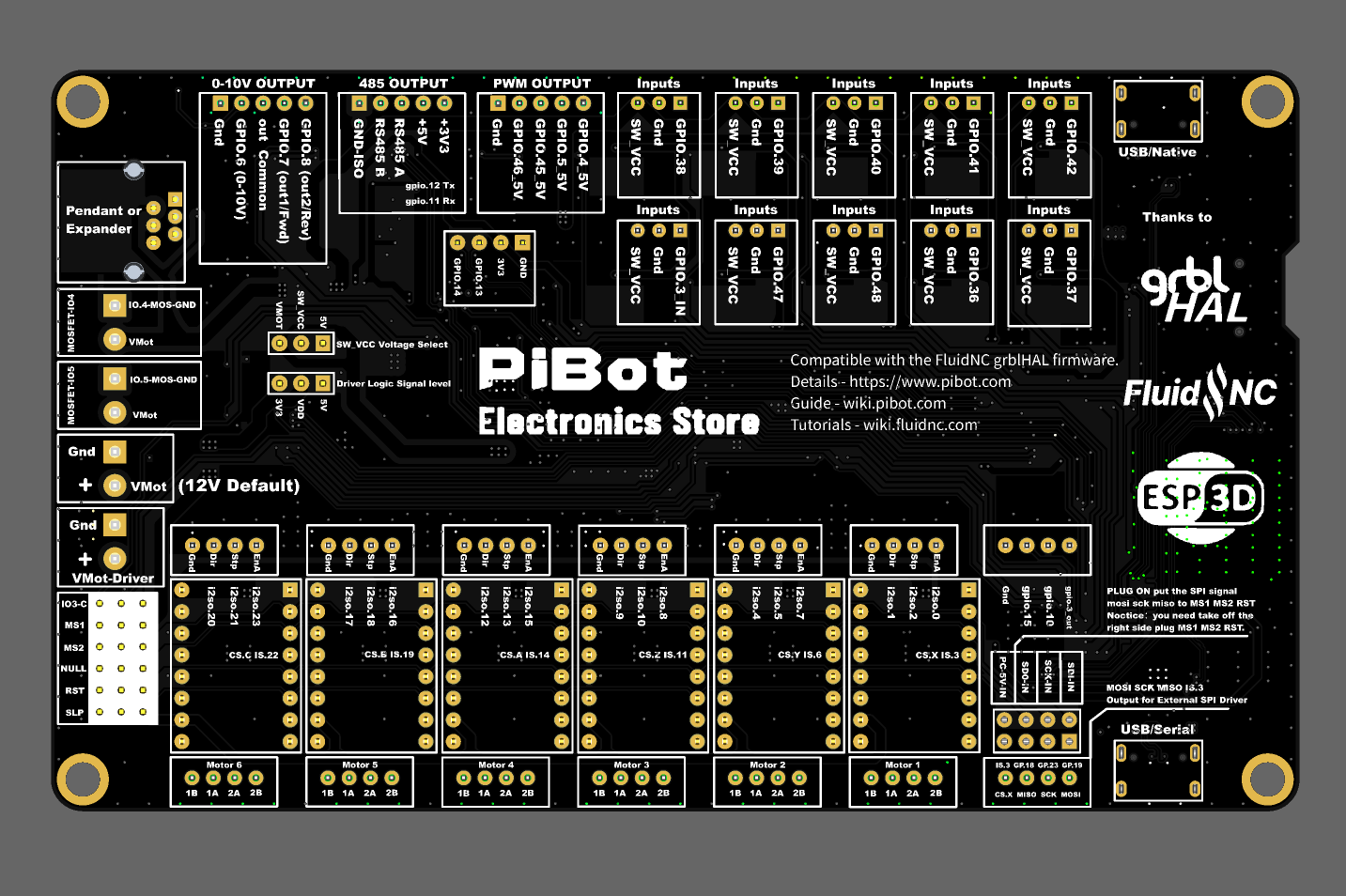
Connector and signal reference
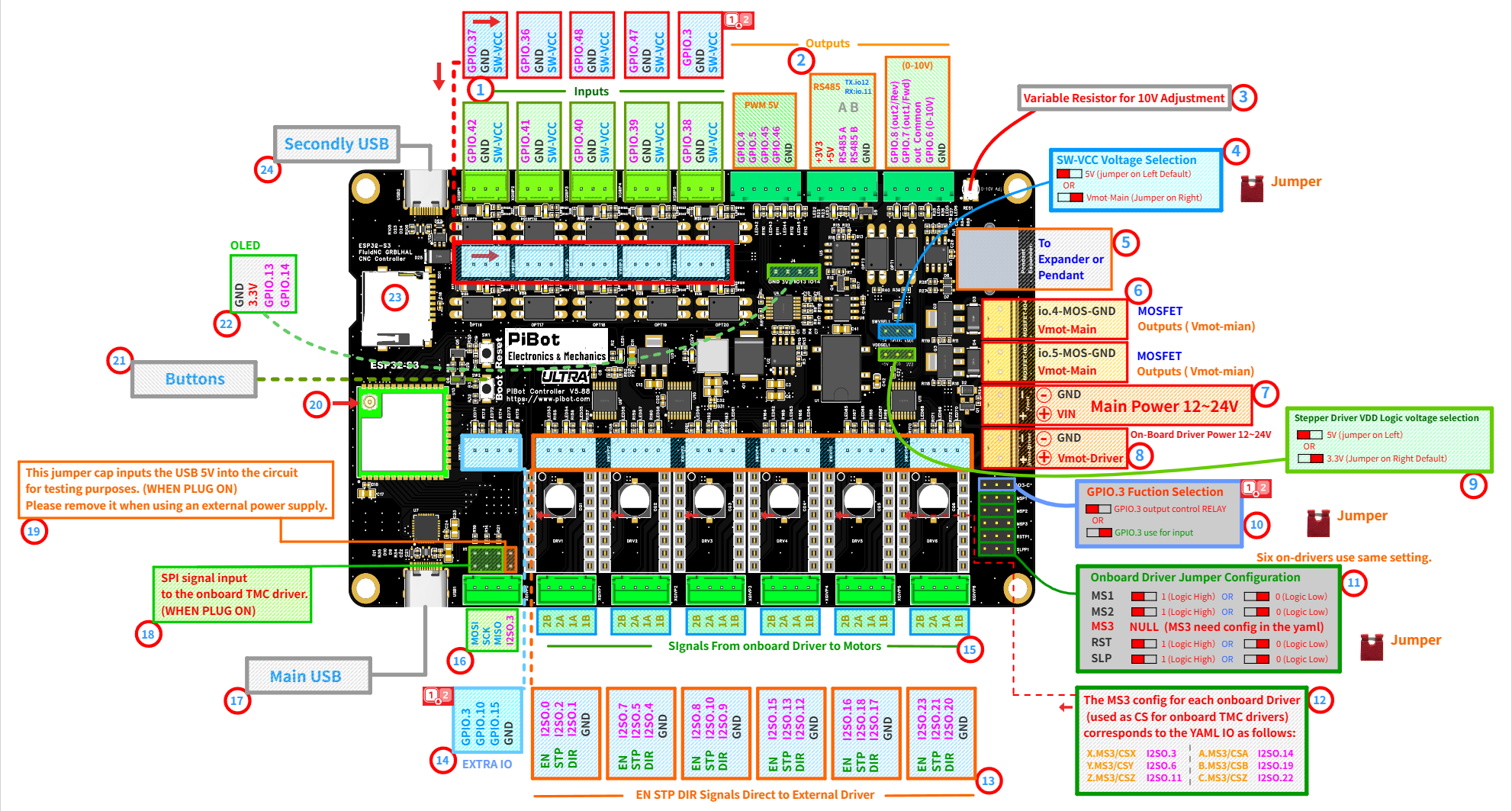
Annotated Pinout Overview — connectors, jumpers and signal groups numbered 1–24. The assignments shown follow the current PiBot test configuration; FluidNC pin functions can be changed in YAML. Open the full Pinout Reference.
Inside the Hardware
| Component | Role in the controller |
|---|---|
| ESP32-S3-WROOM-1U-N8R8 | Main controller; dual-core LX7, 8 MB Flash, 8 MB octal PSRAM and external IPEX antenna connector. |
| TPS54360 | Main step-down power regulation. The complete board must still be operated at 12–24 V DC and never above 24 V. |
| ADUM3201 + B0505XT | Digital and power isolation for the RS485 side. |
| SN65HVD3082E | Half-duplex RS485 transceiver for supported Modbus RTU configurations. |
| TLP521GB-S × 10 | Optical isolation for the ten machine-input channels. |
| NCE6005AR × 2 | Low-side MOSFET output stages with flyback protection; board output limit 500 mA per channel. |
| 74AHCT595 × 3 | I2S/I2SO shift-register chain used for the six dedicated motor signal channels. |
| CP2102 + ESP32-S3 native USB | Two independent USB-C connection paths for serial/flash and supported native-USB use. |
Connectivity and expansion
- Wi-Fi: FluidNC WebUI, file transfer, configuration and network access.
- microSD: G-code/configuration storage when enabled by firmware.
- RJ12: pendant or compatible serial expansion according to the selected firmware and PiBot wiring guide.
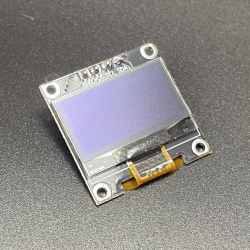
- OLED: dedicated I2C header; availability and configuration depend on the installed firmware and selected options.
- I/O expander: dedicated connector for compatible PiBot/FluidNC expansion hardware.
- SPI header: exposes the relevant SPI signals for documented peripherals and supported driver configurations.
V4.96 Pro vs. V5.88 Ultra
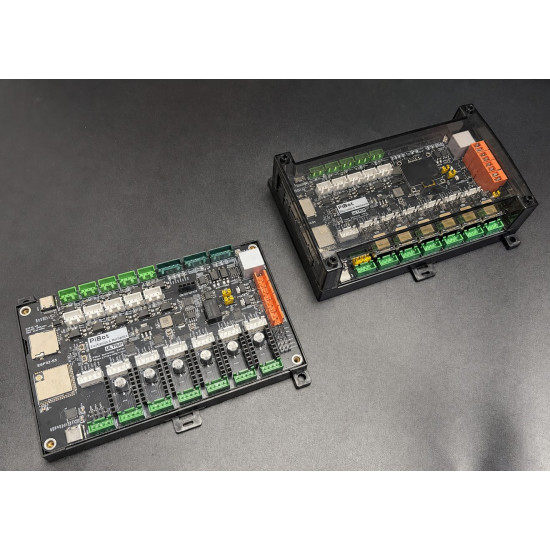
Both boards share the same physical PCB footprint and support on-board or external stepper drivers. V5.88 Ultra is intended for customers who need the ESP32-S3 platform, more inputs, native USB and a fully isolated RS485 interface.
| Feature | V4.96 Pro | V5.88 Ultra |
|---|---|---|
| MCU | ESP32-WROOM-32U | ESP32-S3-WROOM-1U-N8R8 |
| Memory | Standard ESP32 configuration | 8 MB Flash + 8 MB PSRAM |
| Hardware axes | 6 dedicated | 6 dedicated + 1 configurable Extra I/O axis |
| Opto-isolated inputs | 6 | 10 |
| USB | CP2102 serial | CP2102 + native USB, 2 × USB-C |
| RS485 | Standard interface | Galvanically isolated interface and power |
| Status LEDs | 22 | 42 |
| On-board + external drivers | Yes, including documented SPI configurations | Yes, including documented SPI configurations |
| PCB / enclosure footprint | 4-layer, 146.5 × 87 mm | 4-layer, 146.5 × 87 mm; same optional enclosure footprint |
Real-Workbench Review and V4.96 Comparison
CNCWOODSHOP shows the controller on a real workbench, compares it with the V4.96 Pro, and demonstrates the motor-driver connections, inputs, outputs, OLED and pendant options.
Pre-production review unit: current product specifications and purchase options take priority. Operate the board at 12–24 V DC only, never exceed 24 V, and include accessories only when selected above.
Full Specifications
| MCU | ESP32-S3-WROOM-1U-N8R8, dual-core LX7 up to 240 MHz, 8 MB Flash, 8 MB octal PSRAM, IPEX connector |
| Wireless | 2.4 GHz Wi-Fi 802.11 b/g/n; external antenna is included only when selected in the product options |
| Motor channels | 6 dedicated Step / Dir / Enable channels + 1 configurable Extra I/O channel |
| On-board driver sockets | 6 × Pololu 16-pin format; documented A4988, DRV8825, TMC2208, TMC2209, TMC2130 and TMC5160 families |
| External drivers | 6 dedicated 5 V Step / Dir / Enable outputs; Extra I/O may be configured as one additional motor group |
| SPI stepper support | Dedicated chip-select routing for each of the six main channels; configuration depends on driver module and firmware |
| Inputs | 10 × opto-isolated pull-low inputs for dry contacts or NPN/open-collector sensors; switch-side supply selected by jumper; PNP not compatible |
| Digital / power outputs | Buffered 5 V signals, 2 × low-side MOSFET outputs (500 mA maximum each), relay-control output and configurable Extra I/O |
| Spindle / laser | PWM-capable signals, adjustable 0–10 V output and supported Modbus RTU over isolated RS485; assignment depends on firmware |
| RS485 isolation | ADUM3201 digital isolation + B0505XT isolated power + SN65HVD3082E transceiver |
| USB | 2 × USB-C: CP2102 USB-to-serial and ESP32-S3 native USB |
| Storage | microSD card slot |
| Expansion | RJ12 serial/pendant, I2C OLED header, I/O expander connector, SPI header and Extra I/O header |
| Status indicators | 42 LEDs for power, inputs, motor signals, MOSFET and communication activity |
| Power input | 12–24 V DC; never exceed 24 V |
| Firmware | FluidNC ready with YAML configuration and WebUI; an official grblHAL board target is also available |
| PCB / size | 4-layer, 146.5 × 87 mm, four 3.5 mm mounting holes; optional enclosure footprint shared with V4.96 Pro |
Electrical Limits and First Power-On
- Use 12–24 V DC only. Never exceed 24 V. The complete board limit is lower than the headline rating of the main regulator component.
- MOSFET outputs are limited to 500 mA per channel. Larger loads require an external relay or suitable driver.
- Set VDDSEL, SW-VCC and the GPIO.3 tool-setter/Extra-I/O jumper correctly before applying power.
- Do not insert or remove stepper-driver modules while power is applied. Confirm module orientation and current adjustment.
- Test inputs, motor LEDs, PWM, laser, 0–10 V and RS485 without the final machine load connected, following the Wiki sequence.
What Is Included?
The base price is for the controller-board configuration selected above. Some product images demonstrate optional accessories.
External IPEX antenna, connector cable set, plug-in stepper drivers, DIN-rail enclosure, OLED, pendant, relay board and I/O expansion hardware are included only when the corresponding product option is selected and available.
Why PiBot?
PiBot was established in 2013 and designs electronics for CNC, motion control and related projects. According to the PiBot company page, products have reached customers in 68 countries and regions.
- FluidNC ecosystem: open-source firmware, readable YAML configuration, browser WebUI and PiBot starter files make the controller easier to set up and customize.
- Published technical information: the PiBot Wiki provides pinouts, connection guides, example YAML files and tests.
- Flexible driver choices: on-board modules or external drivers can be selected to match different machine sizes.
- Product support: store support, Wiki updates and the PiBot Discord community are available for setup questions.
Documentation and Support
Official and project references
- FluidNC official repository
- FluidNC Web Installer
- Alternative grblHAL board target
- LightBurn supported controller firmware
- PiBot company information
PiBot Controller V5.88 Ultra · Product information updated 2026-08-12
-250x250.jpg "DRV8825 Stepper Motor Driver")


%20(1)-250x250h.png "IPEX to SMA external antenna")
-250x250w.png "IPEX to SMA external antenna")

%20(1)-250x250w.png "PiBot Electronic Box V4")
-250x250w.png "PiBot Electronic Box V4")